Monday, 31 October 2022

A Complete Change Of Course


I'm beached. I was sailing merrily along after publishing Solar Storm, and things looked good. The sea was flat calm and life was almost easy. Then Covid hit. Clouds had already been gathering before then, for no sea remains calm for long, but after that it was a full-on storm. The sequel to the Solar Storm series, Into Darkness (an apt title if ever there was one), didn't do so well. In music-industry parlance, it failed to chart. Loneliness and depression were already lashing at me, and financially things were looking grim. With no demand (seemingly) for any more of my post-apocalypse books, I tried a science fiction book, writing a story that had been with me for some time. It was actually the last of the stories that had been in my head for years.

It flopped. I thought it was a great story, with possibly the best cover I've ever done, but nobody cared. By then I'd reached the end of my tether, and I'd also run out of money. I got a job delivering groceries for a well-known UK supermarket chain. I'm still there.

It's given me a lot of time to think. There's an unmistakable beauty to driving a delivery van to villages in South Shropshire and the Welsh hills. I see the dawn mist in the valleys, and sunsets over distant mountains. It's been very therapeutic, which is pretty rare for a job. I get to see great places and I get paid for it. I cannot complain.

The science fiction sequel I've been writing this year kind of sputtered out and died of apathy. I used to put my heart and soul into my books. I have neither now. I used to be a seat-of-the-pants type of writer, what we in the trade call a pantser, and it's an approach that involves me getting lost in the story to the point of actually living it.  I would start with a vague idea, maybe something for an ending, then I would wing it, wandering through the story and seeing where it would take me. It's a very undisciplined way of writing a novel, but it also creates more of an experience - almost like a drug trip - which enters the story itself.

Unfortunately, pantsing requires a lot of time getting into the role - a bit like being a method actor. And writing when I'm not in the mood it produces writer's block. Or some forced drivel that later gets deleted. Now that I don't have so much time - and being easily distracted by my various troubles - it's a style of writing I can no longer sustain. So I'm left with a choice: find another way to write, or quit.

The opposite of pantsing is plotting. Plotting is logical - you write out the plot beforehand, so that when you start the story, you know exactly what to write next, because you know the plot. I could never get this method to work for me, however. I get my story ideas when I'm in the story. In the zone, so to speak. Out of the zone, I'd stare at the page, just not feeling it, and the page would stay bare, the ideas failing to materialize. But as I said, I'd reached a dead end with my normal style of writing, and while it had a good run, it couldn't continue. So last month I set about constructing a plot for an action thriller, scene by scene.

Perhaps I hadn't persevered enough in trying to write plots before, but this time I managed to create a full scene-by-scene synopsis. Does it have the same soul as my past works? Possibly not, but those stories are written now, and my bank is dry, so I need to make new stuff up. That is a writer's job after all - to make stuff up. A bit like journalism, but without the immorality (and no, I don't buy that crap about journalists writing The Truth. I read their stuff and, as a writer, I see right through that crap. I see the manipulation of emotions and the attempt to lead the reader, because that's exactly how it works in fiction too. Just for different reasons).

And why an action thriller? For the money. I'd been watching Amazon's The Terminal List, and found it to be better than I expected (seeing what streaming services had been putting out recently kept my expectations in the basement). And I used to read thrillers. Plus I always like to include action in my stories, and military or ex-military characters. So I thought it would be a good test for me.

It's a nakedly commercial enterprise, written by hand on paper, often during breaks in my van as I watch sunsets over the hills. I can't say where this is going to go, or whether it will come to anything, but I'm giving it a shot.

Wednesday, 2 February 2022

A Series Name Change


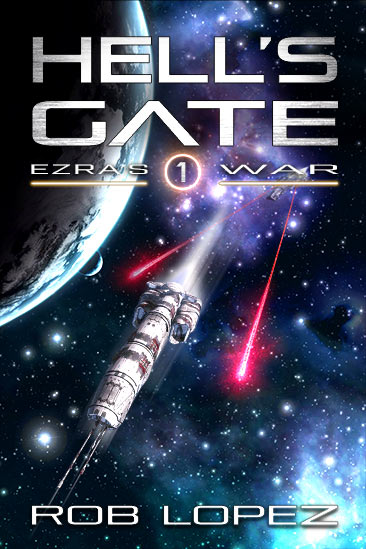
When I first released Hell's Gate not long ago, it was to be the first book in a series known as Gene War. That's bugged me since, because that's a dumb name for a series. In fact, it was a last minute change, as it was meant to be Ezra's war. So I changed it back to what it always should have been. This suits the series better, as it really does revolve around the title character.

One reviewer has already described Ezra as mentally ill. That's not correct, but clearly Ezra's not going to everyone's cup of tea. As an author, that's a risk, but anybody who's read my books should know that I'm not really into vanilla characters. Or vanilla stories, for that matter. Well, each to their own.

Circumstances in my personal life have also changed, leaving me less time to write than before. I already wrote slow, so this pushes any timelines out into the weeds. I could even have a George R.R. Martin moment.

I do my best with what I've been given, but I am working on Book 2. It'll just take time. But Ezra's War promises to be as intriguing as the character himself. With a whole galaxy to play with, I hope this will be as exciting to read as it is to write. It should be worth the wait.

Saturday, 1 January 2022

Asimov's Foundation and Climate Change


In Isaac Asimov's book, Foundation, a character named Salvor Hardin says the following:

"We're receding and forgetting, don't you see? Here in the Periphery they've lost atomic power. In Gamma Andromeda, a power plant has blown up because of poor repairs, and the Chancellor of the Empire complains that atomic technicians are scarce. And the solution? To train new ones? Never! Instead they're to restrict atomic power ... Don't you see? It's Galaxy-wide. It's a worship of the past. It's a deterioration - a stagnation!"

Asimov's Foundation chronicles the decline and fall of the Galactic Empire. If that sounds familiar to you as a Star Wars plot, it's because it is. George Lucas stole the idea wholesale, as have many others. And Asimov himself stole it from the historian Edward Gibbons, who wrote the famous The History of the Decline and Fall of the Roman Empire, first published in 1776.

Curiosity at what makes a great civilization decline and fall has only recently interested Western thinkers. Before the 17th Century, the Roman ruins that lay scattered and crumbling throughout Europe didn't really concern many people. Peasants broke them down for stone to build their houses and wells, and Lords showed scant regard for their preservation. Nobody cared. In Britain folk were either focused on day-to-day survival or making war on the French.

It was only in the 17th and 18th Centuries, when Britain found itself creating the largest empire that had yet been amassed, that certain thinkers began to wonder what exactly happened to the Romans. After all, if the mighty Roman Empire could fall, maybe the British Empire could too.

As unthinkable as that was at the time, serious intellects began to look into it. This was a time when Roman ruins became quite faddish. Rich nobles built ruined follies on their estates, and young gentlemen and their ladies traveled to Italy to marvel at the decrepit ruins that local Italians had never given much thought to. Theories abounded on the symptoms and causes of the rise and fall of civilizations, and it was sobering to think that every civilization that had existed before ours had fallen. Not just a few. All of them. It seemed clear that every civilization had an expiry date, and after the disaster of WW1, thinkers like Oswald Spengler and Arnold Toynbee gained prominence as they delved deeper into the subject.

After WW2 the fad faded. The United States was the new superpower, the new empire of sorts, and a period of hope prevailed that took us eventually to the moon. Asimov, however, had not forgotten his pre-war influences, and the thinking that went before. The passage he wrote above illustrates the dying phase (the decadent phase) of a civilization, where the optimism has faded and civilizations get buyer's remorse.

They stop thinking outside the box and instead retreat to more familiar territory, both figuratively and literally. They play safe and circle the wagons. Religion becomes mysticism and critical thinking becomes pessimism.

Hardin's quote illustrates perfectly, during the different phases of rise and fall, how a civilization solves its problems. Because there are always problems to solve, even when one has become dominant. A failing civilization, however, having sat on its laurels for too long, is unwilling to expend the same amount of effort to solve a problem as they had done when they were a rising, hungry star. In Foundation, the galactic empire is more willing to silence warnings than to heed them, because solving problems is hard. The elites prefer to focus on keeping their power and their wealth, even as they are being warned by the doomsayer Hari Seldon that they will lose both.

We are not short of doomsayers here at the beginning of the 21st Century, and it's tempting to think that Hari Seldon, if he was real, would be one of them, with Climate Change being uppermost in his mind. If it were turned into a very simple contemporary movie, it would have the politicians and business elites all disbelieving the scientist and his young and ardent followers, thus bringing calamity down upon humanity. In fact, I've just described the plot of the new Netflix movie, Don't Look Up (watched it last night, very funny).

But Hardin's quote reminds us that it's not simply a matter of believing in the science and getting the message out, as some in the climate-change movement believe, and I'll give you an example of why, and what it means for the rise or decline of our own society.

Full Disclaimer: I believe Climate Change is real. Despite the subject having been heavily politicized here in the west, with a lot of media and social-media hype, there is, for me, a clear sign that it's not all hype, and that is the fact that Russia and China are spending millions to begin exploring and exploiting the melting Arctic regions, with plans to protect their investments by military means. They see the Arctic as an important geopolitical region of the future, and these are not the type of governments to be swayed by Greta Thunberg throwing a tantrum at the United Nations, or climate activists gluing themselves to the pavement as they block roads or runways to protest government inaction. In Russia or China, that kind of action would see them thrown into a dark prison, with little chance of getting out again. No, these governments have compelling reasons to do what they do, and they have their own scientists. If they believe Climate Change is real, then my guess is that it is.

It's possible you don't believe Climate Change is real, and that's fine, but for this particular example, let's just accept that the climate activists and their supporters claim that they believe in Climate Change, and follow that claim to its natural conclusion to see where it takes us.

And this wasn't originally intended to be a long post, but bear with me on this.

So climate activists, and their media and political supporters, are saying that our industrial societies, with our carbon emissions, our deforestation, consumerism and meat-eating habits are harming the planet, which will lead to global temperatures getting high enough to cause us real harm, and possibly even extinction-level catastrophe.

Fair enough. So what are their solutions? Cut back on industrialization, consume less, eat less meat, fly less and recycle more. And build more wind farms and solar panels.

That's about it. There might be slightly more complex engineering solutions around the edges, like clean-hydrogen engines and the like, but those proposals don't get shouted as much, nor funded much. Now if you look at the above paragraph, do you see how closely it resembles Hardin's quote at the beginning of this article? "Do less and return to the windmills of the past." It's not really a solution. Wind farms and solar panels don't provide enough base load to run a civilization, and are less efficient than the fossil-fuel powered stations they are supposed to replace. Recycling won't cut down on carbon in the atmosphere, because recycling requires energy itself. And cutting back on energy consumption in our societies means willingly adopting austerity, like monks entering a holy order. It should be obvious that people won't do that, no matter what they might say to pollsters. Many societies have had their ascetic types who lived on sand and locusts and practiced soulful meditation. Many still have those who live a simpler life off the grid, returning to traditional methods of living. But these people have always been a minority. Even when called upon by a powerful church to give up worldly pleasures, people rarely do. The Catholic Church could not even get its young men to cease masturbation. Just because someone asks people to do something, doesn't mean they will.

The alternative to asking, of course, is simply to coerce people. Police them. Tax the hell out of them. Make them poor. They'll consume less, then. One doesn't need to be a historian to know how that ends. Remember when I mentioned earlier about the regrowth of mysticism in declining civilizations? Most of the loudest climate activists, including Ms. Thunberg, are gripped by some mystical vision of a very unreal society that, enmasse, willingly chooses eco-piety, and doesn't need to be forced.

And the politicians who now tow the ecological line? How realistic are they? Let me give you an example from my own country of Britain: Our Prime Minister has announced that all new cars after 2030 will be electric. Thereafter the number of polluting internal-combustion engines on our roads will be phased out (helped no doubt by punitive tax tariffs). On the face of it, this could be a good thing. Less pollution, better air quality, less reliance on volatile petroleum markets in geopolitical hot spots, less reliance on fuel that we know will run out someday anyway, and quieter traffic flows. It sounds like the future, right?

Well, it's kind of a lop-sided future, because while the Prime Minister announced these measures over a number of years, I don't recall a speech where he would authorize the mass building of nuclear power stations to cope with the massive ramp up in power use. I also don't recall green activists criticizing him for that. Their only complaint, indeed, is that they don't think Boris is moving quickly enough. They want mandatory electric cars a lot sooner. And electric public transit systems.

It's almost like everyone thinks that electricity is magic, and doesn't need to be produced by industrial means. This is why I sometimes think that activists who claim to be worried about climate change and its effect on people, can't actually be that worried. Because if they were, they would be more serious about solving the problem, rather than just offering faddish lifestyle choices.

Ah, but that's because they are not worried, and it's all just really a conspiracy to deprive people of their freedoms, and ... give power to elites, who can ... do stuff that they can't already do ... for some reason.

No, it's not a conspiracy. It's exactly the kind of thinking that Asimov's character outlined in the book, and it fits with the inadequate problem-solving metrics present in declining societies.

To be sure, nuclear power is only a limited answer. Make no mistake, we are a fossil-fuel civilization. One only needs to look at 17th Century life to see what fossil fuels lifted us out of. More will be needed to move on to the next phase of energy production if we are not to slide backward to being at the mercy of mother nature. Without the fossil-fueled industrial revolution, we would not have the longer lives, education, healthcare, information technology, food production or government systems we enjoy now. Or the individual rights and freedoms that are simply not possible in harsher times or places. So there's a lot at stake.

But if we're not looking at radically new and scalable forms of energy production, then we're not serious about avoiding catastrophe. Largely because people, including college-educated activists, don't understand the sheer amount of effort needed to keep a civilization going. Because our ancestors made it all look so easy. It will take more than windmills and personal guilt-trips to keep civilization going in the face of continuous challenges.

In China, they recently tested a full-sized Thorium reactor. Thorium reactors are safer than nuclear, with more fuel available for them in the world, and produce much less radioactive waste. Why China? We've actually known about Thorium reactors and their benefits for over sixty years now, and programs to test and develop them existed in the US. But they were closed down. We should be building a ton of them now. We have the knowledge, and we were ahead of China in the science. But we gave up.

Now that would have been a serious solution. Another would be Fusion power. Again, the Chinese are ahead in developing this. It requires ridiculous amounts of money in research, but we haven't been willing to commit, and so Fusion power remains science fiction, at least here in the West. Again, another serious solution left hanging.

Do you see what I mean about us not really being serious about solving that which we claim to be afraid of? Instead we make performative gestures, promote lifestyle choices and complain about a lack of piety among the masses. If those don't sound like the actions of some out-of-touch, decadent, self-satisfied aristocracy, then I don't know what does. This is how societies fail.

Hari Seldon would not have been fooled by the climate treaties, play-acting, crocodile tears, messianic rhetoric and mystical movements. He would still have recognized an empire that, whatever it might say, did not really want to survive. And he would have moved his Foundation to China.

Sunday, 4 July 2021

Where I'm At


Hell's Gate


Does it look gloomy? That's just me practicing some photo manipulation. It's actually a photo I took of a cemetery gate in Wales some years ago. I just added the rain and dark skies. But Hell's Gate will be the title of the next novel, though it won't be a gothic urban fantasy. I just needed some art for the article and I haven't perfected any sci-fi pics yet. And I'm quite pleased with what I'm learning with Photoshop.

But in case you missed the last post, the next novel will be military science fiction, and the first of a new series. And it's been hard going. It's now July and I thought I would have finished the first draft by now, but it's taking longer than I realized. I remember when I wrote Solar Storm that I thought I'd bitten off more than I could chew: Following the story from three different points of view, with detailed geographical locations that spanned half the world. Plus I spent a long time agonizing over how exactly Rick would make it home. From the Middle East! Yeah, that took some figuring out. I gave myself that problem. I mean, I could have placed him in Florida. Kept wondering if I should change it. The final result was epic, but I often wondered what the hell I was doing, and why I was making it hard for myself. But that's the way it goes. Sometimes you write the story, and sometimes the story writes you. Or itself. I don't know. But if you want to try something different, you have to learn to catch curveballs. And not complain when they smack you in the face.

So here I am again, dodging demonic pitchers. Hell's Gate not only features multiple POVs, but the world it operates in has to be created from scratch: The landscapes, moons, star systems, weapons, starships, creative physics, political and domestic backdrops ... it takes time, and I'm not done yet. It's going to take a lot of editing to make sure it all works in sync.

I also need to do the artwork for the cover. Now, if I was smart, I'd pay a professional to do that for me. I am smart, but I'm also broke, and good sci-fi covers cost a lot. They're also harder to do than the post-apocalypse covers I'm used to - you can't just take stock art of some location with people and add a color filter. That's why I'm taking a crash course in photo manipulation and digital art. I want the next cover to be absolutely amazing. Because the last cover for Into Darkness was not.

The Into Darkness cover has been bugging me for a long time. I got ambitious, and learned some new techniques, but I completely forgot about making it genre appropriate. This is very important in book publishing, and I knew this, so I've got no excuse. I got neck-deep into the details of the art itself and ended up with a cover that gives readers the impression of being a dark horror novel, rather than an EMP Post-apocalyptic thriller. I poured my heart into that work, then felt deflated when, after putting it out and taking a deep sigh of relief, I took a step back and looked at what I really had.

Into Darkness hasn't sold as well as the preceding works, and I'm not sure if it was the cover, or the concept that moved away from the tried-and-tested 'Going Home' theme. I don't have any regrets about the story itself, but I guess rewards don't always follow risk. Or it could be the cover. It still bugs me. Once I've published my next work, I will revisit that cover, plus the Undead UK covers that now look a little dated. I can do better than that.

What else is there? Oh yes, the Audio books have been a disaster. That hasn't been my fault, but a disaster it remains. I mentioned that the narrator (or rather, the producer for the narrator) for Solar Storm refused to narrate the next book in the series. In fact, they simply disappeared and didn't answer any further inquiries. They had headhunted me for the first book, which flattered me as I hadn't even been considering an audio book, but clearly didn't make as much money as they'd hoped. So they bailed. A smart business decision perhaps, but it felt like a stab in the back. So I auditioned for a new narrator, who worked on the next two books. Unfortunately, after many, many delays and postponements, the narrator pulled out of doing the last book in the series, citing personal reasons. I don't know. I can't seem to catch a break when it comes to audio books, and I wish I'd never gotten into it. I now have a series of four books, with only the first three having audio versions, and it's all taken so long that nobody's really waiting for the fourth anymore. It's going to be difficult to convince a narrator to do the last book of a series, which traditionally sells the least, and I don't have any money to compensate them with incentives, so I'm kind of stuck now and I don't know where to go with it. To be honest, I've given up. It looks unprofessional, but it's a mess I can't easily get out of.

Funnily enough, when I auditioned the last narrator, I had them in mind for Into Darkness, being the perfect voice for a southern gal. Considering how poor the sales have been, maybe it was better they didn't stick with me. Takes a lot of effort with little reward to do an audio production.

Bit like writing, really.

So that's where I'm at. Picking myself up and starting over. I haven't given up, and there are many more projects to follow, but I have had to digest some hard lessons about this business, and I need to figure out a sustainable way of working, and get better at making covers. I took a couple of wrong turns but I'm slowly getting back on track. If I had to make a prediction, I'd say the next book could be out in September. But, honestly, take everything I say with a pinch of salt, because I have no idea really. I can only try my best. But it will be epic, I promise you that.

Tuesday, 6 April 2021

A New Project Is Coming

Boldly going where thousands have gone before.


Something new is coming. A tale of heroism and impossible odds in a galaxy not far away ... well, quite close actually. In fact, the one we're currently in. But a whole bunch of stuff will be far away. And set in the future, with starships, space marines (oh yes), aliens (of course) and battles. Lots of battles. Yes, you guessed it, I'm writing a military science fiction series.

But Rob, I hear you ask. What about a sequel to Into Darkness, or more post-apocalypse fiction?

Fear not, I will not abandon the post-apocalypse genre completely (I like it too much), but I'm kind of burned out, and I didn't have a strong follow-up story for Darla and her crew, and I didn't want to churn out a second-rate sequel just to pad out a series. I want something better than that, and when I have it I will write it. But until then, I have decided to begin a project that's been sitting in my notebooks for a couple of years. How long will it be? I cannot say. When will it be out? Ditto. I only know that I'm 40,000 words into an intriguing story with some complex world-building that's taking time to shake itself out.

So what's it about? A disgraced starship captain who's been granted one last mission, a hot-shot fighter pilot facing her doom and an intelligence officer who's about to discover the frightening truth about the planet they're being sent to invade.

And some other stuff. I can't give too much away, and I might even surprise myself with more stuff before the end. But it is coming. And it's going to pack a punch. Stay tuned.

Wednesday, 27 January 2021

The Story of a Story


Every story has a story, and this is the story of the boat that almost never sailed, and the story that almost wasn't written. In two days, my new novel Into Darkness goes live, which is a great relief as I can honestly say this is the most difficult project I've tackled of late.

I began publishing back in 2012, and I assumed that as I got better, writing would get easier. I mean, nothing could be more difficult than your first novel, right? Wrong. The writing gets better, but you set higher standards for yourself. And that initial stock of story ideas, usually inspired by everything you've read or watched up to that point in your life, runs out. Now you're on your own. Fast forward to 2020, and as I start writing Into Darkness I discover just how far from my comfort zone I am. I knew a little about Louisiana and New Orleans, but not enough to convincingly set a story there. I thought I knew enough about the Mississippi River (it's just water, right?), but as Darla, the protagonist, knows the river like the back of her hand, I realized I needed to know a lot more.

And steamboats. I needed to know about steamboats. Do you know how difficult it is to get real details of a working Mississippi steamboat beyond its ability to float and the view from the deck? I certainly didn't, and in any other story I might have gotten away with only a passing knowledge of such historical craft. In this story, however, the boat is itself a central character, linked closely to Darla. I won't spoil the plot for you, but suffice to say, I really needed a lot more inside knowledge than I possessed when I started the project.

And finally there was the military aspect. Or rather, the lack of it. In every book I've ever written, the main characters have been military or ex-military. I have studied military matters ever since school, where I used to draw fighter planes and tanks in my notebooks instead of paying attention in class. I'm comfortable with military hardware, history and tactics. In Solar Storm it felt perfectly natural to begin the story in Syria because I'd already studied the conflict there for some years. I'm no expert, but I had a reasonable grasp of how a soldier, even a Special Forces operative, would approach a problem.

Not so Darla. She's an ordinary citizen with zero military experience or training, an unusual background and a very particular personality. You'll understand when you read the story. So I was in uncharted territory and I needed to do a lot more research. In fact, I quit the book, not once, but twice, thinking I didn't really have enough to continue with this. I even began to doubt my own abilities as a writer (as any writer knows, continuous self-doubt is an occupational hazard). And of course, this was 2020. Once Covid hit and things went crazy, many things spiraled out of control.

Still seems crazy to me that the first sign of panic was the mass buying of toilet roll. Not just in the US, but all over Europe. As a writer of post-apocalypse stories, I was very humbled by this. In all my stories, and those of many other writers I know, the apocalypse usually began with the stampede to buy food. How wrong we were. It baffles me still to this day. I mean, preppers tend to focus on calorie intake, potable water and shelter, branching further into self-defense, medical items and leaving luxury non-essentials till last. I never pictured, nor portrayed, a typical prepper sitting in a bunker surrounded by toilet roll! Like, WTF.

So yeah, 2020 was weird and people proved to be even weirder. Getting deep into Darla's world while trying to keep my sanity was taxing, and progress was slow, with the result that the book was not ready in time to publish last year. For this, I apologize. It was not meant to take this long, and I was as disappointed as anyone else, but the fault is all mine.

Still, the book is finished and will be available to read very soon (and if you haven't already, you can read the sample first chapter that I've printed in the post below this one). So what can you expect? Well, a rich story set on one of the most famous rivers in literature, and for that I have to thank the late, great Mark Twain, whose influence runs through the entire novel. He not only wrote about it, he was a riverboat pilot with years of experience in navigating the fickle waters of the Mississippi. River pilots were the elite operatives of their day. I recommend his personal memoir of the period, Life On The Mississippi, which shows exactly what it was like, told with his trademark wit and love of detail.

The other big influence is that of Joseph Conrad's Heart of Darkness, whose title is similar to mine. Coincidence? I think not (don't sue me). The idea of a boat sailing up a great river into a dark continent of chaos seemed perfect for a post-apocalypse EMP novel, and I was surprised it hadn't already been done. Well, my own story changed many times during its creation and it doesn't follow either of the books listed above, but the influences are impossible to deny.

The biggest driver of the entire story, however, is the heroine herself, Captain Darla Jean Griffiths. She's quite unlike any of the main characters I've written before. Conflicted, controversial and headstrong, she carries the story on her back and is worthy of a part in any great novel. I count myself fortunate that she decided to appear in mine.

Check it out now on Amazon.

Tuesday, 19 January 2021

Into Darkness


Available at Amazon

New Release!

In post-apocalypse America, one woman will become a legend.

Darla Griffiths is a riverboat captain, giving rides to tourists on her steamboat out of New Orleans. When a devastating solar storm cripples the grid and leaves the local nuclear power plant close to meltdown, Darla is one of the few people who can safely evacuate the citizens of New Orleans before it is too late.

But when anarchy reigns and a hurricane threatens the city, Darla and her crew must risk their lives to save others, and Darla will be forced to confront the darkness of her own past, and the deadly secrets that imperil them all.

Into Darkness is the first of a new series of adventures on the Mississippi River from the author of Solar Storm. Contains moderate language and graphic action scenes.

***

Currently available for pre-order on the above link. Goes live January 29th, just in time for the weekend. Since the pre-order doesn't have the look-inside function, I've included the sample first chapter below.